Owner-controlled data operations · Dealership-first

FreeholdEvidence before interpretation

Keep the operating record your business depends on.

Freehold gives leadership one governed operating record it can inspect, reproduce, and carry forward. Approved source evidence is preserved before interpretation, and approved definitions produce the same answer across teams.

Why Freehold: In law, freehold describes ownership without a fixed end date. Here, the name signals durable control of retained history, approved definitions, and export paths—within applicable law and contract.

Implementation engagements available now · Target first governed view in 3–5 weeks

The target begins after source access, scope, authority, security, and acceptance criteria are agreed. Regulated, multi-source, and enterprise programs require additional gates.

Dealership-first operating intelligence

Eleven operating views. One controlled source of truth.

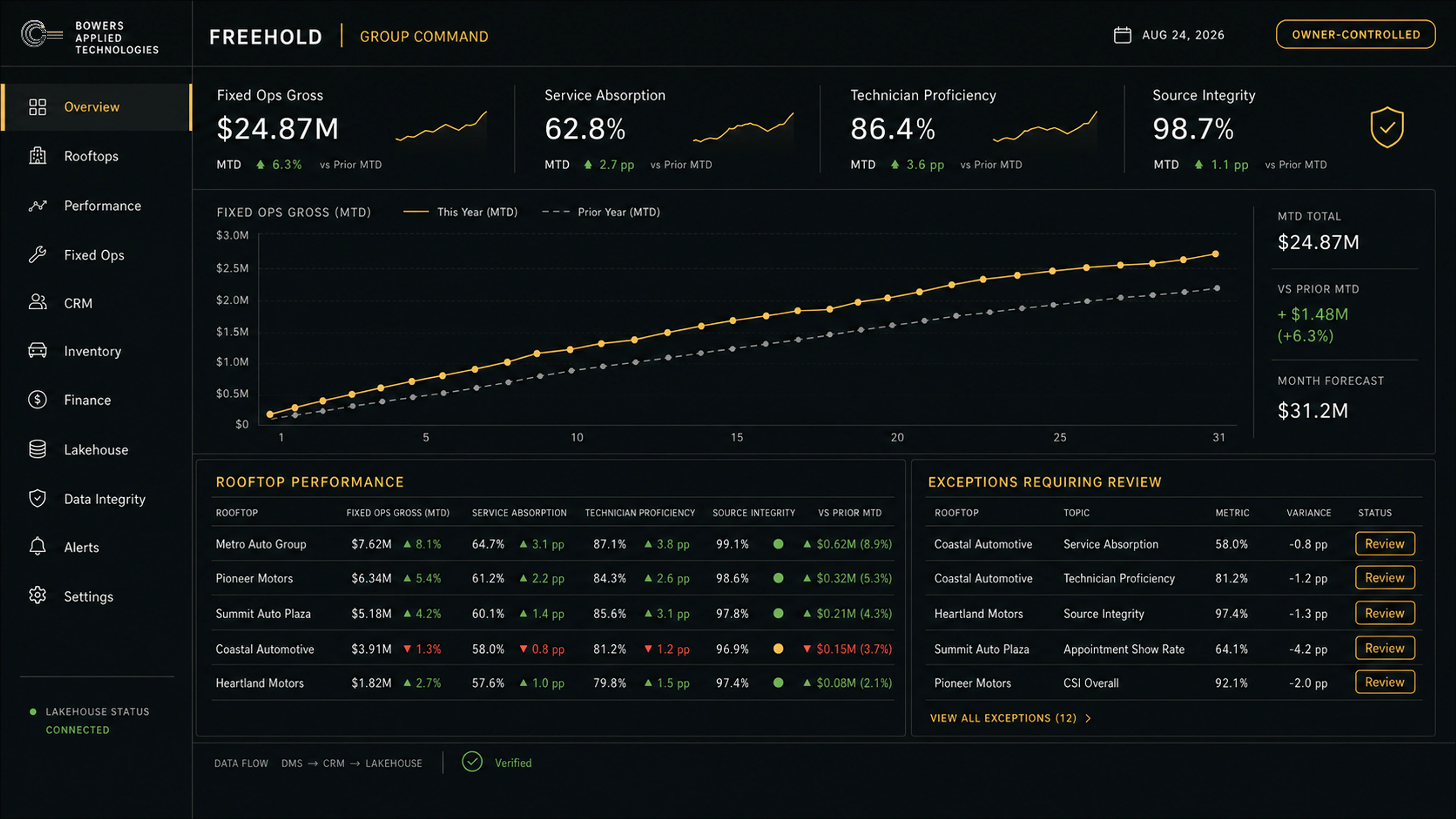
Move through the same executive workspace a dealer principal, fixed operations director, CFO, data steward, or regional operator would use. Every screen is an original 3840 × 2160 concept built with synthetic aggregate values, presented at full fidelity without exposing an implementation or a customer record.

Dealership operating concept11 views · original 3840 × 2160 · synthetic aggregate dataSwipe to inspect the full dashboard.Open full-resolution view
Synthetic Freehold group command dashboard with fixed operations gross, service absorption, technician proficiency, source integrity, rooftop performance, and executive review items.
Dealer principal view

Group command

A single operating brief for group gross, service absorption, technician proficiency, rooftop position, and source integrity.

01 / 11

Original interface concepts built with synthetic aggregate values. They are a deployable design direction, not evidence of live DMS, CRM, identity, cloud, or regulated-system connectivity.

The commercial difference

“Secure” and “customer-controlled” are not synonyms.

Encryption can protect a copy in transit and at rest. It does not answer who controls the transformed model, whose definitions create the report, what uses the contract permits, or what leaves with you when a vendor changes.

Typical vendor-managed analytics

The provider operates the model under its agreement.

A third party may normalize, enrich, and report on data inside its own environment. That can be useful and secure while definitions, permitted uses, derived-data rights, export, and exit remain separate contract questions.

Freehold deployment

Evidence, definitions, access, and exit are governed separately.

Source history is retained, transformations are versioned, definitions are explicit, and approved consumers receive governed outputs. The organization keeps continuity even when one source or dashboard changes.

Vendor contracts differ. Freehold does not assume bad intent; it makes custody, purpose, lineage, portability, and exit rights explicit so “secure” is not the only question being asked.

What staying true means

Keep the record. Define the number. Show the exceptions.

Freehold does not promise perfect source data. It gives leadership a controlled record of what arrived, what changed, how each number was calculated, and what is safe to act on.

  1. 01

    Keep the original

    The record that arrives is kept intact before anything is calculated.

  2. 02

    Agree on the number

    Your team approves what each headline measure means and when that definition takes effect.

  3. 03

    Show the exceptions

    Unknown, late, or conflicting input is flagged instead of quietly estimated.

  4. 04

    Carry it forward

    History, definitions, and approved exports remain available when a system changes.

One operating answer

Stop debating whose report is right

The company approves each important definition once, and every governed view uses that same definition for the same period.

Visible exceptions

Know when a number is not ready

Missing, late, or conflicting inputs are shown for review. The system does not turn an incomplete control into a green checkmark.

Business continuity

Keep the history when systems change

Retained records, approved definitions, and agreed exports carry forward. A new source may need controlled integration work, but the operating history does not restart.

Automotive first. Not automotive only.

The same operating discipline can serve other high-accountability industries.

Dealerships are the reference implementation and the center of this product story. The same ownership, evidence, access, and portability pattern can be tailored for hospitals, insurers, and public agencies when their legal, security, and operating boundaries are separately accepted.

Regulated deployment boundary

Compliance follows the deployment. It does not come from a sales page.

The architecture is designed for strong custody, minimization, access, retention, and evidence controls. A regulated claim still requires the exact customer, environment, contract, authority, and acceptance evidence.

Healthcare

A healthcare deployment requires the covered entity's risk analysis, defined permitted uses, applicable business-associate agreements, and accepted safeguards before protected health information enters scope.

HHS cloud guidance

Government

A government deployment follows the agency's authorization boundary and information classification. Federal cloud work may require a FedRAMP-certified service plus agency-specific authorization.

FedRAMP scope

Insurance

An insurance deployment must map the applicable state requirements, risk assessment, third-party oversight, retention schedule, and cybersecurity-event duties for that licensee.

NAIC Model Law 668

A bounded first implementation

Three to five weeks to a first decision-ready view.

The first engagement is deliberately narrow: one important decision, approved sources, an accountable owner, and a governed view the business can accept or reject. It is a proof of value—not a disguised enterprise rollout.

  1. Week 1

    Choose the decision

    Choose one operating decision, the approved sources, the accountable executive, prohibited uses, and the security boundary.

  2. Week 2

    Secure the first source

    Connect an approved read-only source or supplied extract, retain the original, and hold unusable data for review instead of guessing.

  3. Week 3

    Deliver the first operating view

    Build the agreed measures, decision controls, and executive dashboard around the question the business chose.

  4. Weeks 4–5

    Prove it with the business

    Test access, exceptions, repeatability, user acceptance, documentation, and handoff against the agreed criteria.

The ownership promiseYour data does not become our asset.

The agreement defines the customer's data rights, our permitted processing, retained history, organization-specific definitions, exportable outputs, and the reusable platform software owned by Bowers Applied Technologies.

Source authorization, identity configuration, legal and security review, network boundaries, data quality, and regulated obligations control the schedule. Additional source systems or enterprise rollout stages extend the engagement rather than being hidden inside the initial range.

Start with one decision

Bring us the number the business needs to trust.

Start with the systems involved, the decision they should support, and the data-use terms you refuse to compromise. We will scope the smallest implementation that can prove the model in your operation.